
The short answer
AI helps scaling businesses by removing work that grows in direct proportion to volume: enquiry handling, onboarding, reminders, reporting and CRM upkeep. It does not help when demand is the constraint, when the process is still changing, or when the real bottleneck is one person's decision-making. Fix the constraint you actually have.
Most owners we meet are not short on talent. The business is held together by people, inboxes, spreadsheets and memory, and that arrangement works perfectly well until volume doubles. Then it starts dropping things, and the instinct is to reach for another pair of hands.
What actually breaks when you grow
Some work stays flat as a business grows. Strategy, pricing, the annual accounts. Other work grows in a straight line with volume, and that is the work that breaks first.
Enquiry handling. Onboarding packs. Document chasing. Appointment reminders. CRM upkeep. The monthly report rebuilt by hand from the same 4 sources. Each of these is manageable at 20 clients and unmanageable at 80, and the transition happens without anybody noticing it happen.
The trap is that none of it ever feels urgent. Each individual task is 10 minutes. It is only when you add them across a month that the number turns into a hire, and by then you are hiring to keep up rather than to grow.
The work that breaks first is the work that grows in a straight line with volume.
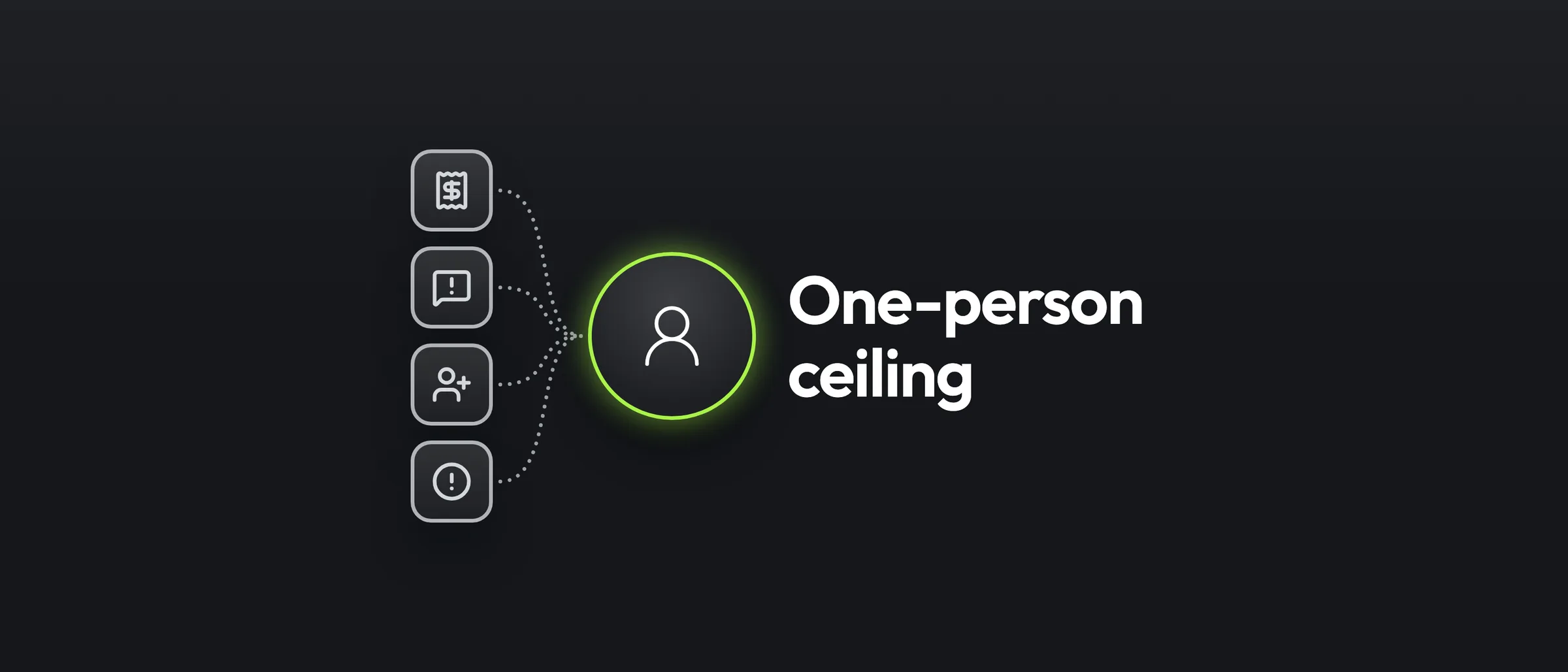
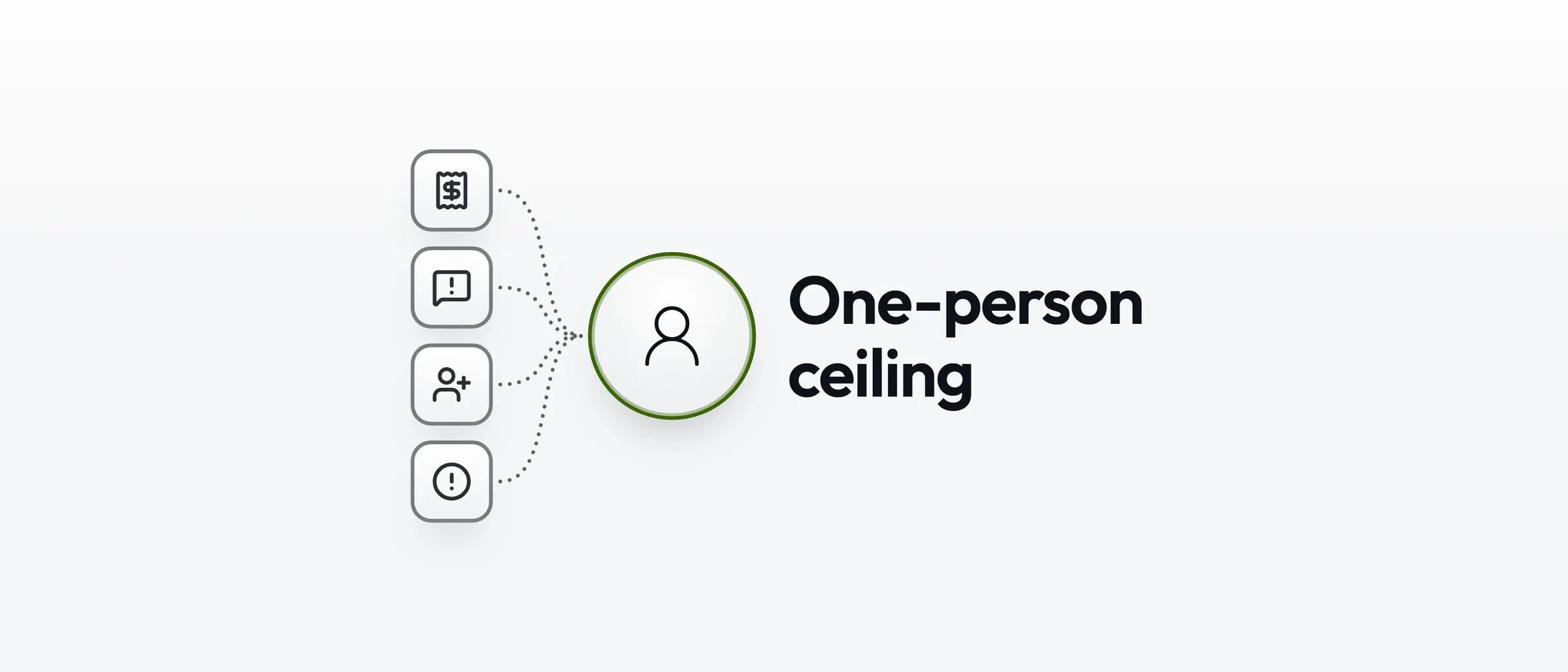
The one-person ceiling
In most growing service firms the real constraint is not capacity, it is a person. Every quote goes through them. Every complaint. Every hiring decision. Every exception to every rule.
That person is usually the owner, and they are the reason the business is any good. They are also the reason it cannot take on 30% more work without something slipping, and no amount of software changes that on its own.
What AI can do is move some of the load, drafting what the owner would have written, summarising what they would have had to read, and surfacing only the decisions that genuinely need them. What it cannot do is take over the judgement, and any supplier suggesting otherwise is selling something.
Where it pays during growth
Response time on enquiries comes first, because the value of a lead falls fast and the ones arriving after hours are the easiest to lose without ever knowing you lost them.
Onboarding is second. A repeatable pack that used to take 40 minutes a client becomes the thing nobody has time for, and clients notice the difference between week 1 and week 6.
Reporting is third, because rebuilding the same view by hand every month is pure cost and the numbers land too late to change anything. Handovers are fourth and least visible: as headcount grows, the gaps between people are where work gets dropped, and they multiply faster than the headcount does.
ARCoach went from no infrastructure to 3 connected systems in around 4 weeks, and Adrian reports the practice now signs 2 to 3 new clients a month.
When AI is the wrong answer
Three situations, and in each of them the spend goes nowhere.
Demand is the constraint. If enquiries are low, handling 4 leads a week faster still leaves you with 4 leads a week. That is a marketing problem in a systems costume.
The process is still changing. A build assumes a stable shape, and if the shape changes monthly the build needs rewriting before it pays back. Train the team instead and revisit it in 6 months.
Or the bottleneck is a decision rather than a task, in which case automating everything around the decision maker only makes the queue arrive faster.
The order that works
Map where the week goes before buying anything, because most owners are wrong about which task costs the most and the wrong guess is expensive.
Then remove the highest-volume repeated work one system at a time, finishing each before starting the next. Half-built systems are worse than no systems, because staff route around them and keep the manual process running in parallel, so you pay for both.
Then hire onto a business that already has working systems, so the new person inherits a process rather than a folder of tribal knowledge and a fortnight of somebody else's time. Hiring into chaos reliably multiplies the chaos.
Where to start
Take the 5 tasks your team repeats most this month, multiply each by frequency and rough duration, and put an annual number on it. Most owners find it larger than they expected, and the number is what makes the case rather than anything about the technology.
The Free Business Check is a 30-minute call on your business priorities and bottlenecks. It ends in your AI Recommendation Plan, yours whether you hire us or not. If a system is the wrong answer for where you are, that is in the first conversation.
Frequently asked
Free resources
Ready to remove the work itself? Start with Workflow Automation.